Dahlia Le Tourneau
August 10, 2026
Finding motivation from unexpected twists
As I wrap up my research on translating colonial-era Zapotec language religious texts (see my first post here- https://tichablog.org/uncategorized/working-with-confessionals-an-introduction-from-dahlia-le-tourneau/), I reflect on the unexpected challenges I encountered within these texts and the learning that these challenges have initiated.
For example, though I do most of my work in the database that facilitates translation (FLEx), there are sections of the text where I must return to the original. To do this, I go to a section called the baseline, through which I can compare the database to the original text, as well as separate different strings of words where I recognize and record spelling variants of words or phrases. I sometimes must come to terms with the fact that that the part I am looking for is not in the original. For example, one line of the text I recently translated, has a phrase in the contemporaneous Spanish translation that is not present in the original Zapotec. The Spanish translation, which is a response to a previously asked question, states:
Sometimes I have believed them, because they are very scary. Other times not.
The Zapotec, on the other hand, states:
There have been times that I have believed in those animals because _______. There have been times that I have not believed.
The Spanish “translation” of the Zapotec gives a reason for believing in the animal’s cries (i.e. omens) while the Zapotec text does not. This left me with many questions as to what can be happening. Is part of the Zapotec text missing? Or is that section left as a “fill in the blank”, given that this text is a confessional? If that is the case, why was a response given in the corresponding Spanish text? These questions are not always resolveable, but they are interesting to think about when looking at translations!
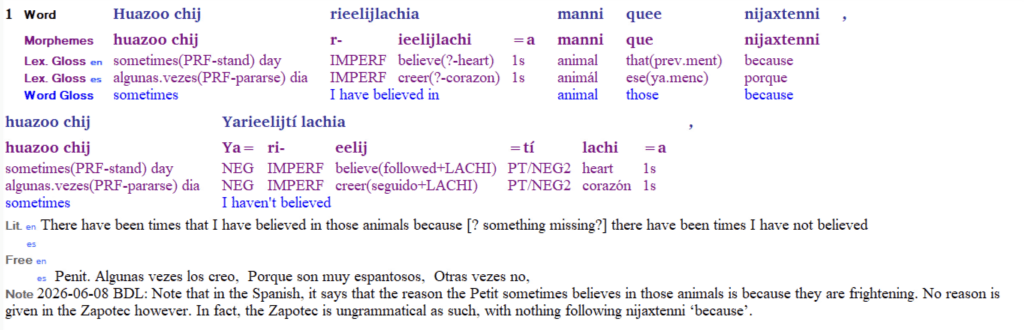
This example comes from the text I was working on, on pages 7-8 of the Aguero confessional which I am translating. I noticed how there is a section that is present in the Spanish, yet not in the Zapotec. A note was created, and I moved on with the work!
As seen above, most of the Colonial Zapotec text in the Confessional has a corresponding original Spanish translation. For the most part, Broadwell or Lillehaugen had already associated that corresponding Spanish to the Zapotec in the database for the sections I am working on. However, there have been times when I have worked on sections where the association of the Spanish translations had not been completed. In these sections, in addition to needing to translate the Zapotec, I also needed to find and associate the corresponding Spanish translations.
Despite certain difficulties such as these, I found myself more motivated than discouraged. I started to recognize words or patterns and understand how long paragraphs may all fit together, searching for spelling variants or unknown words now comes at greater ease using both the lexicon and concordance features of the database. Even when things were not as expected, I became further inspired to translate everything that I could in order to learn and share as much as possible in a way which can allow people to understand the texts. *I touch more on this idea of accessibility rather than authoritative “accuracy” at the end!*
Learning about “witches” and “enchanters”
Among some of the last lines I translated, we see mentions of witches and soothsayers. The Spanish translation dives into the topic of witches and enchantresses and the priest questions the penitent’s belief in them. However, when we look at the original Zapotec we are able to see more details about practices performed by these soothsayers! Though hechijlla on its own typically is translated soothsayer or fortuneteller, I noticed xoba, the word for corn, directly after it. This reminded me of another similar phrase which means to throw lots using corn kernels!
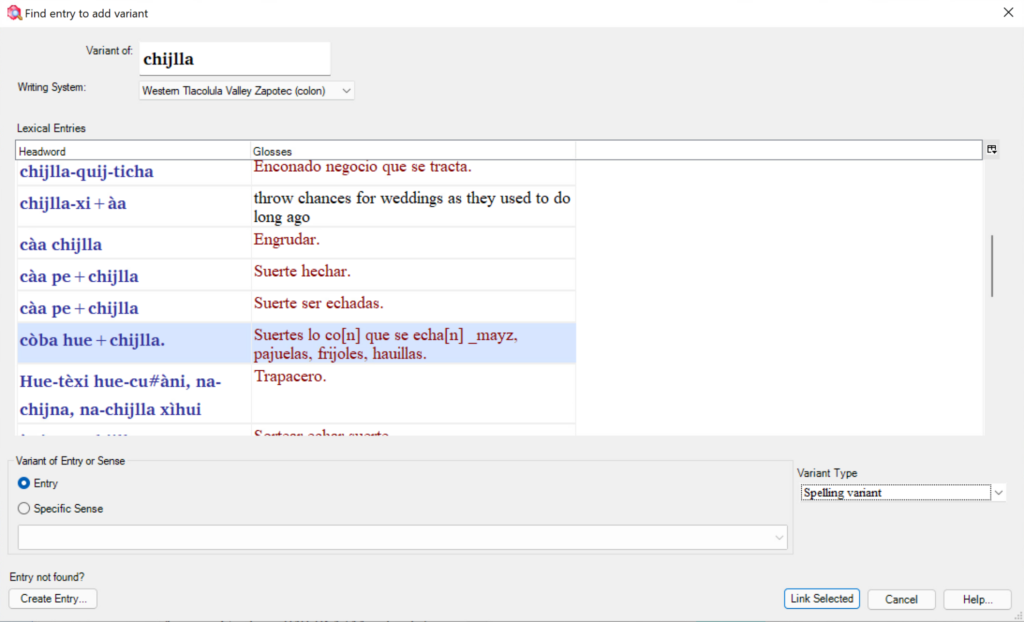
An example of a similar phrase which means to throw lots using corn kernels!
Through collaboration with Professor Brook Lillehaugen, the combination of this word for corn following the word for soothsayer or fortune teller led us to believe that this section spoke about people who practiced divination through corn kernels, which is a known practice of the time.
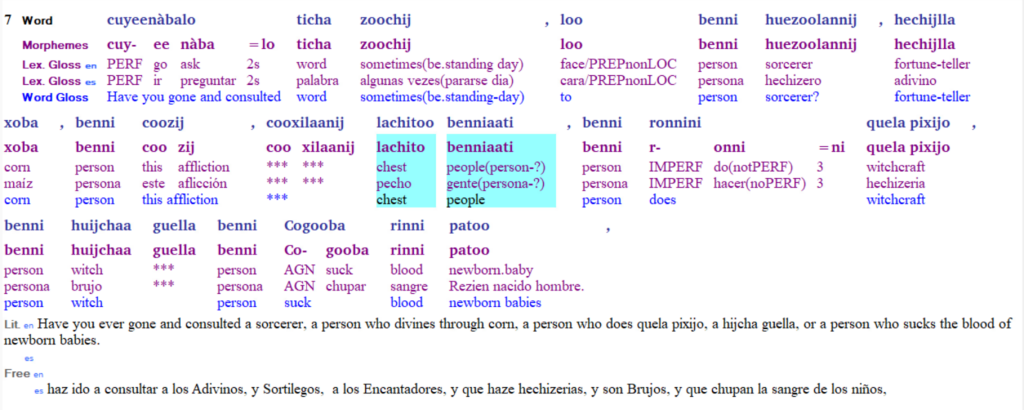
The combination of the words hechijlla and xoba together has been interpreted to mean a person who divines through corn
When comparing the original Spanish translation to the recently translated Zapotec, we can see how certain details were left out from the Spanish such as in this example which spoke about divination through corn rather than just simply naming soothsayers or fortune tellers. This section of the text was extremely interesting to work with due to the spiritual and cultural information it reveals, along with figuring out the differences between the original Zapotec and Spanish.
Translating for accessibility rather than authoritativeness
Through my translations this summer, I came to recognize the fact that translations are not always going to be fully accurate. This can be due to both intent and cultural context. Though I am trying to translate the Zapotec for accessibility, so were the original Spanish translations. However, by operating with specific goals and purposes we can see how many aspects from the original Zapotec were left out of the original Spanish translations. Similarly, there may be aspects of my translations that have been left out or are inaccurate. Furthermore, we must question whether cultural categories within Zapotec, Spanish and English are truly lining up. There are areas within the text where we may be unable to “get it right” due to differences in how different cultures understand different concepts. When translating huijchaa to witch, how can I be sure that the beings described were seen in the same context as witches in Zapotec culture? For instance, I noticed that Witch and Sorcerer can sometimes be different translation options for the same Zapotec word, and yet those two words carry different context and descriptive details with them!
Of course translations will not always successful because that would simply be impossible. Sometimes the Spanish translations missed the mark and, likewise, sometimes ours will miss too. Overall, I believe that these translations should be seen as a tool for accessibility rather than an authoritative declaration of what the text “really says”. While my translations supply some level of access, they are not the same as truly speaking and understanding the language within its own cultural context. I would urge the questioning of translative work that is blindly presented as fully “right” or “wrong”, even if a translator’s purpose is to be helpful! Perhaps this work isn’t 100 percent correct- but I encourage anyone who is interested to re-translate it, re imagine it, and draw your own conclusions.
Resources and references
Works cited
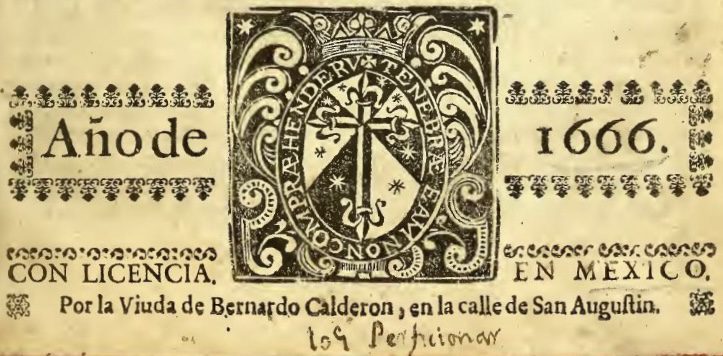
de Agüero, Cristóbal. 1666. Miscelaneo espiritual, en el idioma zapoteco. México: Por la Viuda de Bernardo Calderon, en la calle de San Augustin.
Broadwell, George Aaron and Brook Danielle Lillehaugen. 2026. FLEx Database for Colonial Valley Zapotec (50,384 lexical entries, 738 texts), unpublished.
Additional Resources
https://ticha.haverford.edu/en/texts/aguero-miscelaneo/4/original
Credits and contributors
Published: August 10, 2026
Author: Dahlia Le Tourneau
Reviewed & edited by: Brook Lillehaugen
If you have any questions, comments, or suggestions, the Ticha team and I can be reached at tichaproject@gmail.com.