Elsa Bishop
June 23, 2026
A bit about me
Hi! My name is Elsa Bishop, and I’m a rising sophomore at Swarthmore College, planning to major in linguistics and this is my first summer working with Zapotec languages! I’ve loved learning about languages and linguistics ever since my sophomore year of high school. A lot of the time I would have difficulty understanding the academic papers I wanted to read and wouldn’t be able to get much farther than the introduction. Now that I’ve learned how to read these articles, I want to help make them more accessible to anyone interested in understanding them. This summer, I’ll be working with the Ticha team to share some of the technical research papers written about Colonial Valley Zapotec. My goal is to summarize these papers using terms that you do not need a PhD in linguistics to understand! Whenever possible I will link the original article as well.
HINT: if an article is ever behind a paywell, please just email the Ticha team at tichaproject@gmail.com. Authors are often willing to provide “digital off-prints” directly to those who request them free of charge.
I hope this series reaches anyone interested in Zapotec and Mesoamerican languages!
Zapotec texts and dictionaries
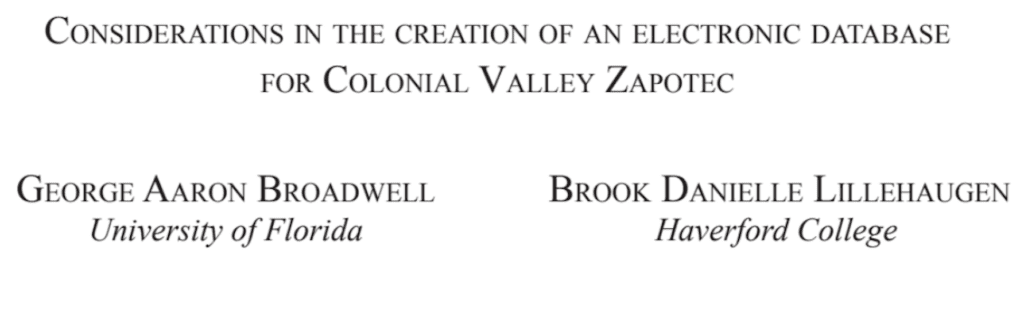
In 2013, Ticha co-directors Brook Danielle Lillehaugen and George Aaron Broadwell published an article in the International Journal of the Linguistic Association of the Southwest entitled “Considerations in the creation of an electronic database for Colonial Valley Zapotec”. Lillehaugen and Broadwell are both linguists and this article explains how they worked to create a database by working with a large range of texts from Colonial era Mexico that were written in Valley Zapotec (or “Colonial Valley Zapotec”). There are lots of different kinds of texts written in Colonial Valley Zapotec: from printed Spanish-to-Zapotec dictionaries, to handwritten legal documents such as wills. You can see two examples below that illustrate this difference.
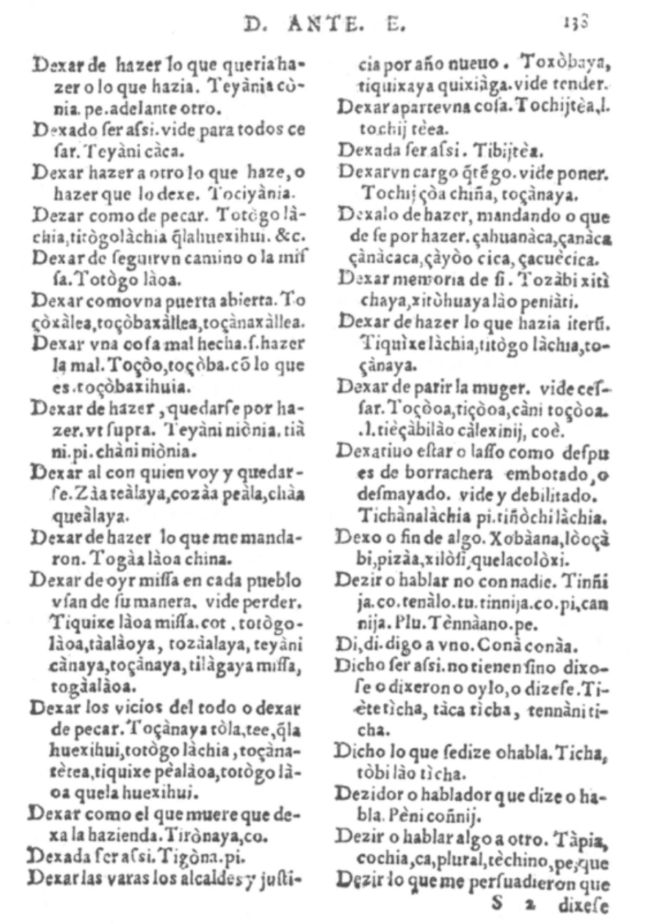
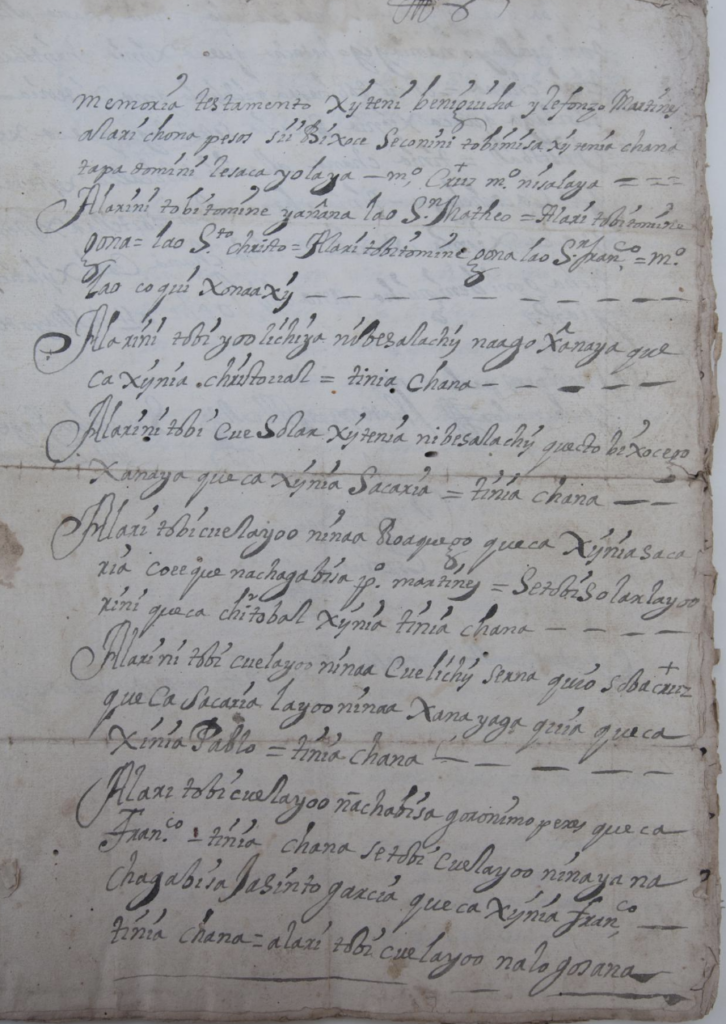
The first image displays an example from Cordova’s Vocabulario dictionary, while the second image shows the handwritten last will and testament of Alfonso Martínez from Teotitlán del Valle. https://ticha.haverford.edu/en/text/Tv716/overview/
Another important issue that Broadwell and Lillehaugen discuss is complications regarding how words are spelled in the corpus. When the Spanish colonizers came to the Americas, they first encountered a language called Nahuatl. They were able to make a solid Romanization for Nahuatl, then they moved south, expecting to find more Nahuatl speakers, or at least people who spoke a similar language. However, Zapotec is completely unrelated to Nahuatl, is extremely different, and would be difficult to write with the Roman alphabet due to its sound system. In addition, the family of Zapotec languages has many different varieties. What all of these factors resulted in is that it is a challenge to tell whether a spelling or grammar choice is made because of a genuine difference (perhaps a dialect difference), or perhaps because the application of the Latin alphabet was influenced by its use for Nahuatl languages, the writers understanding of the use of the alphabet for Spanish, or some other reason.
Notably, one of the major Zapotec dictionaries of the time, credited to the Spanish officer Cordova, has Spanish headwords and Zapotec translations, but no Zapotec-to-Spanish translations. This makes it so that a user is unable to search up a specific unknown Zapotec word. An exciting digital resource has been created based on the Vocabulario that allow users to search for a Zapotec (or Spanish) word, (Oudijk & Miceli 2015, based on Smith Stark et al. 1993. https://www.iifilologicas.unam.mx/cordova/), but as it is based on the Vocabulario alone, not the entire corpus, it of course cannot provide a full range of spellings and uses of words. In this case, it is necessary to be able to use every historical document available to fill in the inevitable gaps in the Vocabulario. This need for a way to consult or help translate Colonial Valley Zapotec texts is where the Ticha team have come into play.
The FLEx database
The Ticha team aims to make these documents more accessible in many ways, including by entering them into the Fieldworks Language Explorer (FLEx) database. FLEx is a program designed to create an analyzed corpus of texts and a dictionary at the same time. Beyond that, these two become interconnected and are able to be accessed by each other. It also provides analysis backed against previous input.
The major issue the team has run into using FLEx for the Colonial Valley Zapotec corpus is the huge amount of spelling variations. FLEx is built for languages that have a standardized spelling system. Colonial Valley Zapotec is an historical corpus and was written in a way that was not standardized. A single word can be spelled more than twenty different ways! You can imagine that this is sometimes a challenge to the usefulness of FLEx when suggesting possible matches in the corpus, which is typically one of the strengths of the program.
Despite this, the Broadwell and Lillehaugen Colonial Valley Zapotec Dictionary makes interacting with and translating Zapotec texts much easier. It provides the Ticha team with a database in which they can filter for specific letters, words, and even sentences in Zapotec, Spanish, and English. Furthermore, it automatically searches for the same or recorded spelling variants of words in Zapotec while working on translations and suggests possible matches. These FLEx advantages and many more make working with these historical documents considerably more manageable.
I really hope that this database can continue to improve on the baseline it has created, and I hope whoever is reading this finds it useful! If you are interested, below is the full citation of the article I summarized, and we should have a full version available for free soon!
Resources and references
Broadwell, George Aaron & Brook Danielle Lillehaugen. 2013. Considerations in the creation of an electronic database for Colonial Valley Zapotec. International Journal of the Linguistic Association of the Southwest 32(2): 77—110.
Credits and contributors
Published: June 23, 2026
Author: Elsa Bishop
Edited by: Brook Lillehaugen & Dahlia Le Tourneau
Formatted by: Dahlia Le Tourneau
If you have any questions, comments, or suggestions, the Ticha team and I can be reached at tichaproject@gmail.com.